When messaging breaks in a complex organization, the first instinct is often to fix the words. But in most B2B businesses, inconsistent messaging is not just a copy problem. It is a sign that strategy, product, sales, marketing, and local markets are not yet aligned around how the story should actually work in practice.
It is easier to believe the problem lives in the copy. That feels fixable, safe, and contained.
If the issue is just language, then the solution seems straightforward: sharpen the proposition, rewrite the deck, create a new tagline, and ask everyone to use it.
But that logic breaks down quickly inside international businesses.
Because now the story has to survive contact with Group strategy, product and innovation teams, sales leadership, PR, central marketing, regional teams, country teams, and different customer realities in different markets.
At that point, the question is no longer just, “What should we say?” It becomes, “Can this organization align around how the story gets used?”
That is a different challenge entirely.
In complex organizations, messaging does not fragment by accident. It fragments because different parts of the business are solving different problems.
Product teams want precision. Sales wants speed and relevance. Brand wants consistency. Regional teams want flexibility. Country teams want what works locally. Leadership wants one story. Customers want clarity.
None of those needs are unreasonable. But they do not automatically align.
So the organization starts generating workarounds:
From the outside, it looks like a messaging issue. From the inside, it is usually a system issue.
Below the first screen in DS Smith's Showpad app 'Let's Talk'. In other words: which country are you in, langauge would you like to hear the story in, or localized version you would like to hear ...
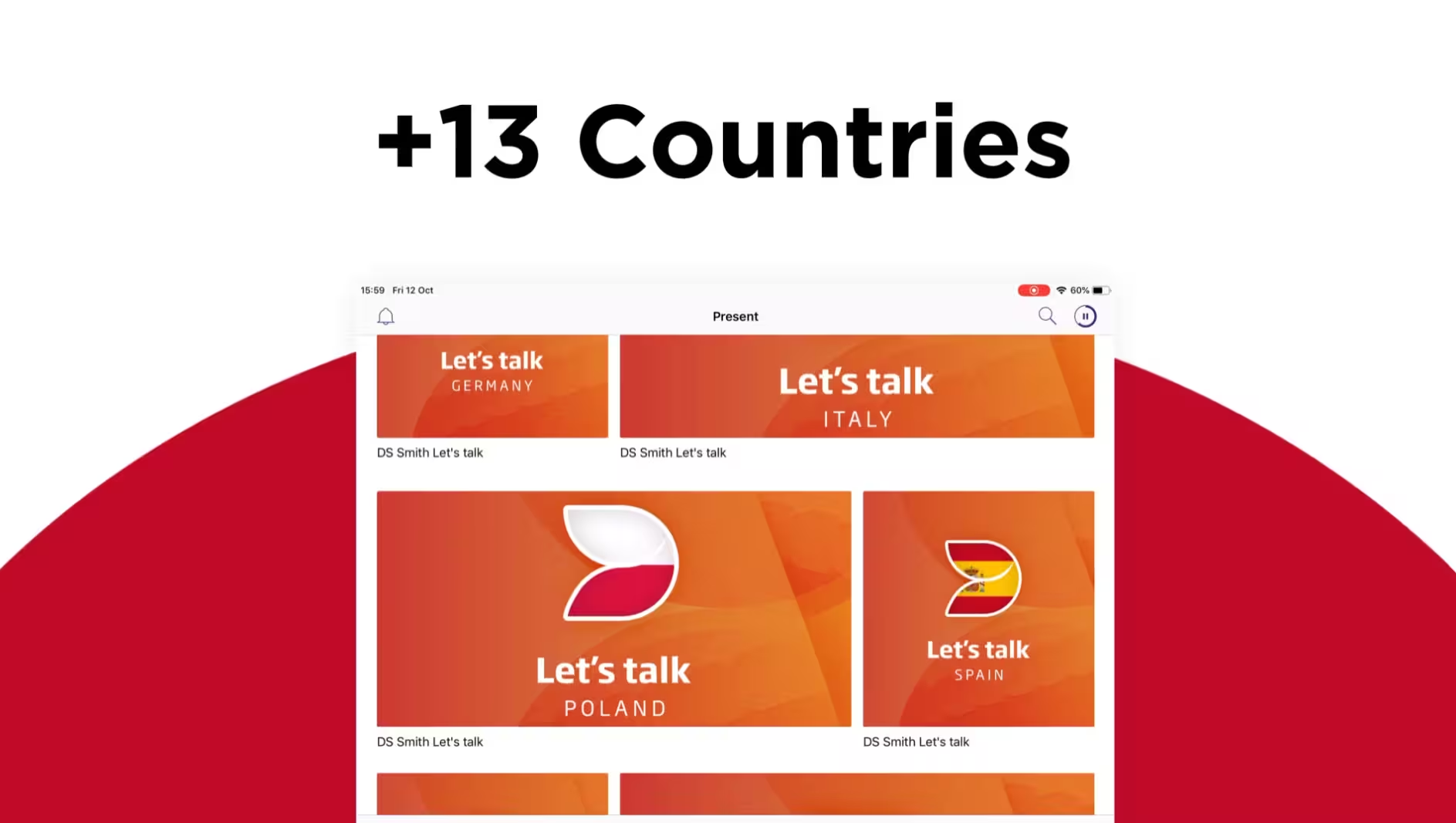
Good copy matters. But good copy cannot solve competing stakeholder agendas, unclear ownership, product complexity, fragmented content structures, weak adoption models, local market drift, or absent governance.
This is why so many messaging projects disappoint. The words improve in the center, but the confusion remains at the edges. And the edges are where the market actually experiences the brand.
That is why alignment has to go beyond phrasing. It needs structure, decision rights, commercial logic, adoption paths, and a way for the business to move together without losing flexibility.
Real alignment is not when everyone uses the exact same sentence. It is when different parts of the business can operate from the same strategic logic without pulling the message apart.
That means:
That kind of alignment does not come from polishing language alone. It comes from translating strategic intent into something the organization can actually carry.
Messaging breakdowns are often treated as communication failures. So the response becomes more guidance, more workshops, more playbooks, more internal campaigns, and more pressure on teams to “stick to the message.”
But if the message is not usable in context, more pressure does not solve the problem. It just increases the gap between central intent and local reality.
I have seen this more than once: the central team feels the story is finally clear, while the field quietly keeps adapting it to make it workable.
That is not resistance. It is a signal.
A different screen in DS Smith's Showpad app 'Let's Talk'. By integrating a map of all global office, we started to involve local marketers in the narratif: one app, by you, with you, for us ...

Misalignment does not stay in brand. It spreads into slower campaigns, weaker sales conversations, duplicated content work, harder local activation, confusion in product storytelling, and inconsistent customer experiences.
Eventually, companies start paying a tax on their own internal complexity.
Not because they lack smart people. Because they have not built a shared structure for how the story travels across the business.
That is why enterprise alignment is not a copy problem. It is an operating challenge with strategic consequences.
Instead of asking: “Have we found the right words?” Ask:
Those questions take you closer to the real problem.
And usually, to the real work.
There is nothing wrong with improving the copy.
But when the same messaging problems keep coming back, it is usually because the business is trying to solve organizational misalignment with language alone.
That almost never works.
Because the problem was not a lack of words.
It was a lack of shared commercial structure.
I lead every stage personally - from interviews and diagnosisto alignment and activation.