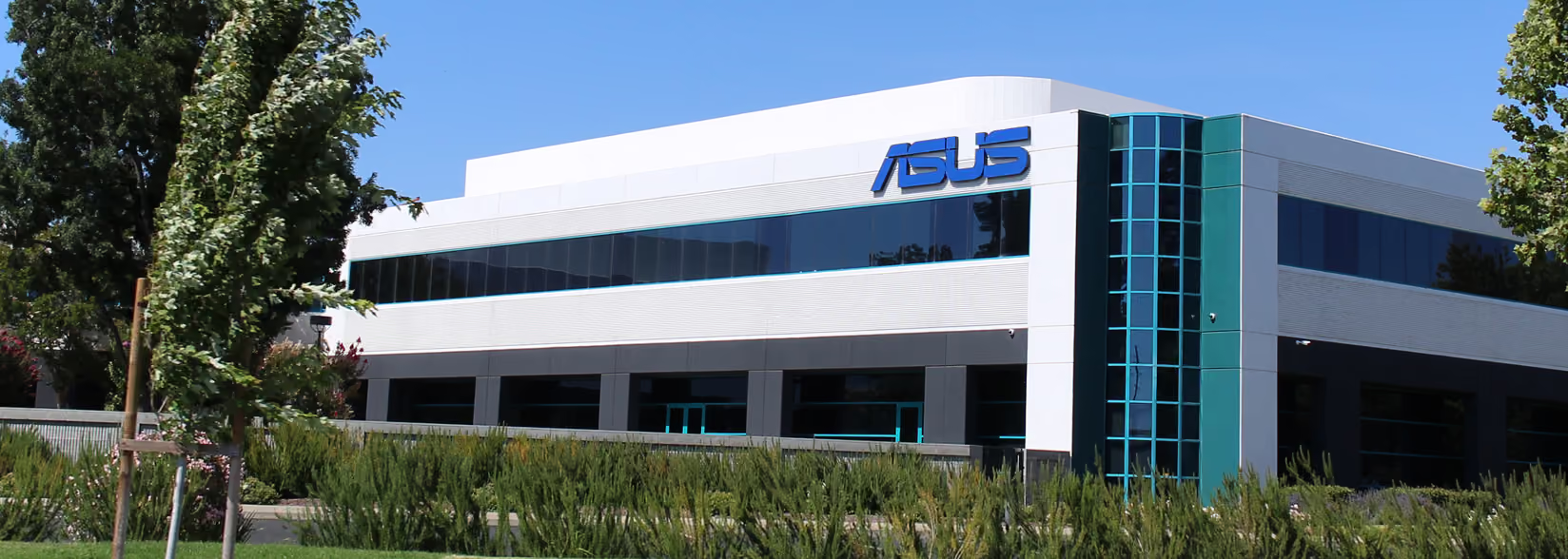
ASUSTeK (via TD Synnex)
Building a new category before we fully understood the market
About
ASUSTeK (via TD Synnex)
Positioning
Product Manager, responsible for identifying the portfolio opportunity, onboarding ASUS and developing the category through forecasting, pricing, allocation and close vendor collaboration.
ASUS unlocked category growth, pricing power and smarter allocation.
Situation
When the portfolio needed to become more complete
By the time I was managing Intel at Tech Data, the limits of the existing components portfolio were becoming increasingly visible. Customers were not buying processors in isolation because they were building complete systems, which meant they also needed motherboards, graphics cards, memory, storage, cases and other components before they could deliver a finished product to their own customers.
The implication was broader than simply adding more SKUs. If Tech Data could only supply part of the system, customers still had practical reasons to consolidate their purchasing elsewhere. Every missing category weakened the overall proposition, even when our pricing on individual products was competitive.
That changed the way I looked at portfolio growth. The objective was no longer to maximise isolated product lines, but to identify the missing categories and vendors that would make the overall business more relevant to system builders.
Identifying the gaps competitors were already exploiting
I started comparing our assortment more systematically with that of competing distributors. The exercise was simple, but useful: which important brands were they carrying that we were not, and where were those brands appearing repeatedly in customer demand?
ASUS stood out quickly. The company had a strong technical reputation, was receiving positive attention in specialist media and had meaningful positions in motherboards and graphics cards, both of which complemented the Intel business directly. Customers were already familiar with the brand, while competitors had demonstrated that there was an addressable market.
That combination reduced some of the uncertainty around the decision. The question was not whether demand existed, but whether Tech Data could build a category strong enough to capture it.
Realising that signing the vendor was only the beginning
Adding ASUS to the line card would not have solved the problem by itself. Distribution only creates value when the right products are available at the right time, in sufficient quantities, at prices that allow both the distributor and its customers to compete effectively.
That required decisions about which models to stock, how much inventory to carry, which launches deserved early commitment and how pricing should move as market conditions changed. Those decisions were difficult to make well without a strong understanding of the category.
At that stage, I did not yet have that expertise. I knew enough to see the opportunity, but not enough to manage the business confidently on my own.
Using the vendor relationship as a learning engine
Rather than treating that knowledge gap as something to hide, I addressed it directly. I went to the ASUS account manager, Nick Geurds, and explained that I wanted to build the business but needed him to help me understand the category in depth.
We began reviewing forecasts, orders and pricing together every week. Those sessions became much more than operational check-ins because they gave me access to a wider view of the market than I could develop from Tech Data alone.
We could discuss which products were starting to move, where shortages were developing, how competitor pricing was behaving and which models were likely to gain momentum. I also gained a better understanding of the way ASUS itself thought about launches, channel priorities and allocation.
That changed the speed at which I could learn. Instead of building category knowledge slowly through isolated transactions, I was able to combine customer demand, vendor intelligence and actual sales data into a much faster feedback loop.
Moving beyond reactive ordering
The closer collaboration also changed the way purchasing decisions were made. A reactive model would have waited for demand to become obvious before placing larger orders, but by that point the best pricing or allocation could already have disappeared.
I began asking more questions earlier in the cycle. Which products were expected to become important? Where was supply likely to tighten? Could we secure allocation before demand peaked? Were there pricing opportunities available if we committed volume sooner?
That made the commercial relationship more proactive. Instead of simply receiving offers from the vendor, we were increasingly discussing what the market was likely to need next and how Tech Data could position itself ahead of that demand.
Combining vendor intelligence with customer reality
The model became stronger because it connected two different sources of information. Sales teams were hearing directly from customers about the brands, products and price points they wanted, while ASUS had visibility into broader market movements, product launches and supply conditions.
Product Management could use both sides of that information to make better decisions. Customer demand prevented us from building the category around assumptions, while vendor intelligence helped us act earlier than local demand alone would have allowed.
This created a much better commercial rhythm. Forecasting became more informed, inventory decisions became more deliberate and negotiations with the vendor were grounded in a clearer view of both expected demand and market conditions.
Building credibility with the vendor
The relationship with ASUS strengthened as the business developed. A distributor becomes more valuable to a vendor when it can demonstrate that it understands the category, commits intelligently and turns supply into sustainable customer demand.
That credibility mattered when products were constrained or when new launches required allocation decisions. Access is rarely distributed equally when supply is tight, so the quality of the relationship and the confidence the vendor has in the distributor become commercially important.
The stronger the relationship became, the more useful the information flow became in return. Better access created better decisions, while better decisions made Tech Data a more credible partner.
Strengthening the customer proposition around Intel
ASUS also contributed to something larger than its own category performance. Motherboards and graphics cards strengthened the system around Intel and reduced the number of products customers still needed to source elsewhere.
That improved the economics of the wider customer relationship. Tech Data could support more of the full PC configuration, which reduced purchasing fragmentation for customers and increased the share of wallet available to us.
The value of ASUS was therefore both direct and indirect. It created a new category opportunity while also making the existing Intel business more attractive because the surrounding portfolio had become more complete.
Creating a repeatable model for category expansion
The experience also changed how I approached subsequent vendor opportunities. Portfolio expansion became less about adding brands opportunistically and more about following a repeatable logic.
First, look for real customer demand and visible gaps in the current offer. Then identify the vendor that can fill that gap, build direct relationships with the people who understand the market best, and combine their information with signals from Sales. Finally, use that intelligence to manage pricing, forecasting, allocation and inventory more proactively.
That model later became relevant across other brands and categories because it provided a more disciplined way to expand without relying purely on instinct or vendor pressure.
From missing brand to strategic category
ASUS ultimately became important for more than the revenue it generated. The relationship helped Tech Data strengthen its components proposition, improve pricing and allocation decisions and gain faster access to category intelligence.
It also demonstrated how quickly capability can be built when the organisation is prepared to learn directly from the ecosystem around it. The starting point was a clear gap in the portfolio, but the more lasting value came from developing a better way of understanding and managing new categories.
What began as a missing vendor became part of a broader shift in how Tech Data built the components business: closer to customers, closer to vendors and increasingly able to act before the market had fully moved.
Shift
- Built a competitor-based expansion plan to identify missing brands
- Secured Asus as a strategic addition to the portfolio
- Replaced independent decision-making with weekly vendor collaboration
- Openly acknowledged lack of expertise to accelerate learning
- Shifted from reactive ordering to proactive product and pricing strategy
Clarity Engine Alignment assessment
Results
- Strong growth in a newly introduced product category
- Improved pricing, allocation, and promotional support
- Faster, data-driven decision-making based on real market insight
- Increased credibility with both vendor and internal stakeholders
- Earlier access to high-demand and newly launched products

Defining moment
Instead of pretending to understand the category, I asked the Asus account manager to walk me through every decision. Week after week, we built forecasts, pricing, and orders together. What started as a gap in knowledge quickly turned into a direct line to market insight, pricing power, and growth.

Client feedback
Testimonial




insights
Related
insights


Start with diagnose
Answer 5 questions. See where your commercial system is losing clarity.
A short diagnostic built on the Alignment Matrix. It points to where friction is most likely sitting — not a definitive answer.